Newsletter signup

Your Enquiry

Inition

Everything in 3D

'People Wood' 3D Printed Infosculpture for Something and Son

3D Printed Infosculpture
Redmond Community Centre
Trees Opening

The Brief
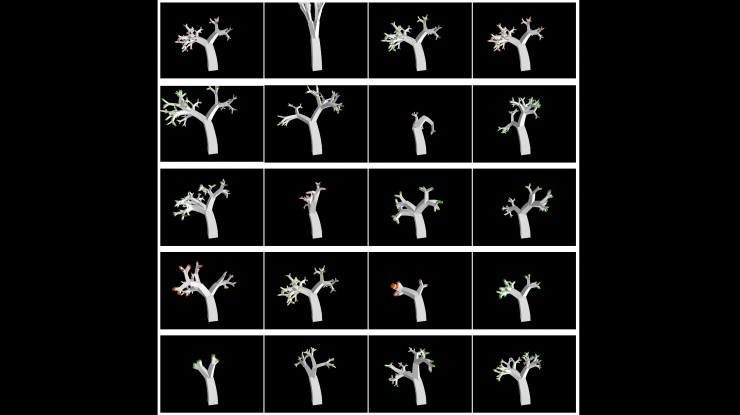
Manor House Development Trust, a charitable social enterprise centred in Hackney, commissioned Something & Son to create a sculpture to take pride of place in the new Redmond Community Centre at Woodbury Down in North-East Hackney. Something & Son approached Inition for help creating a crowd-sourced data sculpture featuring a forest of over 400 3D-printed trees, each corresponding to an individual’s answers to an online questionnaire.

Solution
From the start, this artwork has been a vehicle for innovation and is the first time that online data has been transformed into a 3D printed sculpture.

Inition’s creatives developed bespoke software in order to map the collected data to the tree ‘growing’ process. The online questionnaire asked residents questions about their social lives, about how long they had lived in the Manor House area and how often they interacted with their neighbours. Answers to these questions were used by Inition to determine various aspects of each tree’s physical appearance, for example:

Diversity of origin = Roundness of tree trunk and branches
Years lived in the Manor House area = Length of the branches
Interaction with neighbours = Spread of the trees branches
Overall sense of happiness = Bushiness of the tree

The colour of the branch tips signifies the individual’s overall sense of community, the stronger this is gauged to be, the more fruit the tree will bear- resulting in brighter tips.


The collected data was transformed into over 400 trees, all of which were printed in-house at Inition on our ZPrinter450.

To complete the sculpture the printed trees were sent to the Redmond Community Centre where they were hung upside down from a wire grid modelled on the local topography.

Results
The complete sculpture has now been installed at the Redmond Community Centre where it will remain permanently as a reminder of the flourishing community that the centre serves. Counter to the usual data representation of communities as large aggregated data sets and trends, the subtleties of the sculpture bring complex, personal data to life in a sculptural form.

Related Case Studies: 

'Permission to Explode' 3D Scan and Print for ATYP

Image(s): 


The Brief
Inition was approached by creative design agency ATYP to provide a 3D scan and 3D print of musician Si Begg’s head for the launch of his new album on Addictech Records. The resulting  work was turned into album artwork and an experimental stop motion video entitled, ‘Permission to Explode’, to coincide with the launch.


Si Begg: Permission To Explode from ATYP Limited on Vimeo.

Solution
Because of the high levels of detail that have to be captured in order to accurately reconstruct facial expressions and textures such as hair, 3D scanning faces can be a complex business.

In order to produce the high quality print that ATYP required for the video, Inition’s 3D scanning team selected the Mephisto 3D Scanner for Si Begg’s head. This scanner is capable of capturing high detail incredibly quickly and enabled our team to scan Si’s head from all angles in less than half a day.

Once we had completed the scan and cleaned the data in post-processing, it was sent back to ATYP, allowing them to manipulate the file to fit their creative brief. When Inition received the newly edited version, Si’s head was no longer a solid 3D mesh but had been sliced into 17 equally-sized sections.


Inition decided to 3D print two heads, one solid and one sliced up. Our ZPrinter 450 took just one day to print out both heads in-house at our Shoreditch studios.

To view more about the making of the film watch this video:


Si Begg: Permission To Explode Making Of from ATYP Limited on Vimeo.

Results
ATYP created a 30 second stop-motion animation using coloured rods which moved around a grid in waveforms, with the seventeen 3D slices of Si’s head coming together to form segments.

This animation was then united with work in other media including projection, scripting, live action and CGI to create a final piece which embraces the concept of hyper-creativity that inspired Si Begg’s album.

The short film was published online and emailed out to Si Begg’s fans to promote the new album.

Merlin Nation, co-founder of ATYP stated:

“The 3D scanning and printing work we did with Inition was a crucial element in the success of this project. Their expertise, professionalism and willingness to help us experiment ensured that we got the results we needed.”

3D-Printed Breakfast for The Times

Image(s): 
The Bowl, Cup, Saucer and Watch we designed and printed
Composite image showing wireframe and 3D print of our fruit bowl.
The finished video on The Times website
A 3D printed Barbie leg!
Some of the objects we printed


The Brief
The Times approached Inition for a glimpse into the future of how 3D printing might be used in the home. The piece was to be photographic-led and feature on a double-page spread in their monthly magazine Eureka.

Solution
Inition worked with the editorial staff to develop an idea based on a 3D-printed breakfast table setting. Inition's 3D artists then started work on each of the pieces.

The full list of pieces included a side plate, a large plate, a cereal bowl, a coffee cup, a saucer, a milk jug, a cuttlery set, a fruit bowl, an egg cup, reading glasses, house keys complete with a Eureka branded key ring, a cafetiere, toast rack, a butter dish, a vase, a watch and a 3D printed Barbie leg!
 
All prints were completed within two days on our in-house ZPrinter 450 in a single colour. The photography session (art-directed by The Times) involved laying out the objects in a breakfast setting complete with cornflakes, a boiled egg, fruit, flowers and toast!
 
Results
The resulting photograph was centre-page in Eureka magazine and the accompanying behind-the-scenes video is viewable below. The story about the piece was the 5th most read item on the The Times website on that day highlighting the amazing interest in this technology. 3D printing opens up a wide range of new opportunities for 3D designers and mass-customised manufacturing and Inition is very excited to be at the forefront of exploting the technology in a wide range of applications.


Future of 3D: #2 - Sketch, Sculpt, Print!

Image(s): 
Kristin's model, printed in two colours
Some of Kristin's sketchbook work
Kristin with her finished 3D printed model
Kristin sculpting her model with the Phantom haptic arm
Inition's Paul Armand cleaning off the 3D printed model
Inition's Paul Armand with Kristin and her 3D printed model
Some of Kristin's sketchbook work
Screenshots of Kristin building her design with Sensable's Freeform haptic sculp


Future of 3D
Inition’s “Future of 3D” series encourages work on non-commercial projects which help to push the boundaries of current 3D creative and technology. This was the first time we had seen a project go from sketched concept, through haptic modelling to a physical 3D printed model. Organic designs are not usually immediately associated with computers but with Claytools strength in creating organic shapes and our 3D printer's ability to print them, we see a great future for this combination of technologies in product design.

Kristin with the Phantom Omni and her 3D printed model

The Brief
As part of Inition’s “Future of 3D” series, our 3D printing team agreed to work with BA design student Kristin Katzer from the London College of Communication to realise a packaging design for fruits.

Solution

Concept- The concept for Kristin's organic design was based on structures of nature, in particular her research into “tafoni structures” produced during the calcification of porous sandstone.

Freeform DesignDesigning these organic structures using a typical 3D CAD package would have proved very difficult, however with Inition's guidance Kristin realised the design through the intuitive interface of the Sensable Phantom Omni in conjunction with the Claytools software. Claytools is a design package specially tailored towards haptic modelling, allowing the user to directly sculpt, manipulate and feel the surface of a model through a pen-line interface attached to a motorised force-feedback arm.

3D PrintAfter adding colour to the CAD model, the complex design was prepared for print Paul Armand, one of Inition's 3D printing specialists. Our full colour 3D ZPrinter 450 printed out the model over-night including two end caps with extruded lettering.

Results
The final design forms part of Kristin’s degree and was shown at the BA Design Show at the London College of Communication in June 2011.

Thanks to Kristin for creating a great piece; the first thing we've 3D printed that has been created on a haptic device. 

The kit we used:  ZPrinter 450, Phantom Omni with Claytools software

Check out our Future of 3D blog at fo3d.posterous.com for our latest experiments.