

Future of 3D
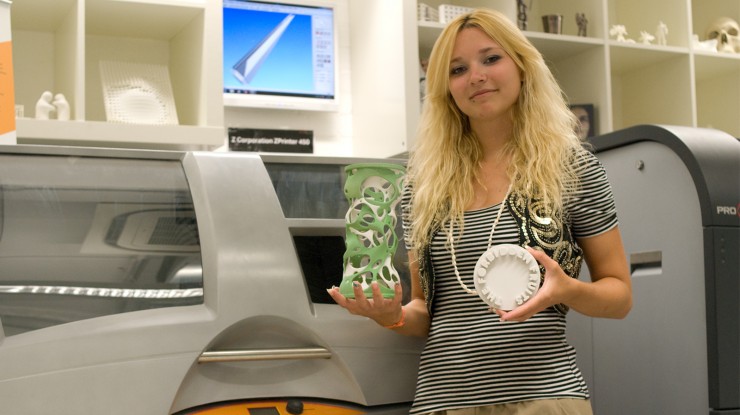
Inition’s “Future of 3D” series encourages work on non-commercial projects which help to push the boundaries of current 3D creative and technology. This was the first time we had seen a project go from sketched concept, through haptic modelling to a physical 3D printed model. Organic designs are not usually immediately associated with computers but with Claytools strength in creating organic shapes and our 3D printer's ability to print them, we see a great future for this combination of technologies in product design.
![]()
The Brief
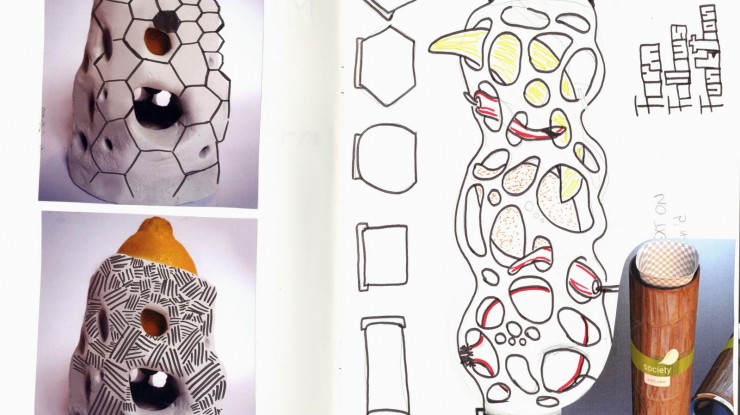
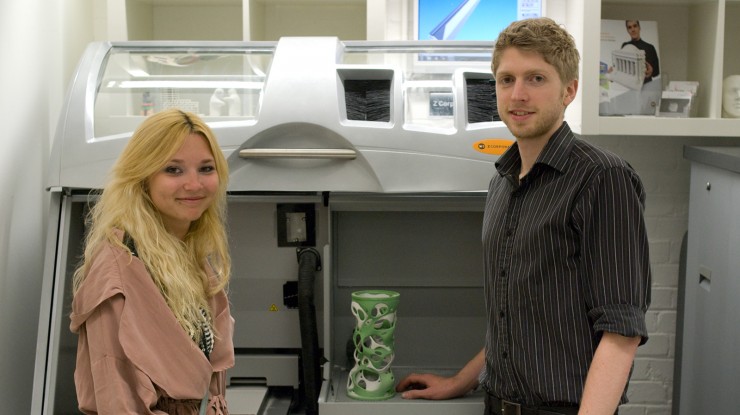
As part of Inition’s “Future of 3D” series, our 3D printing team agreed to work with BA design student Kristin Katzer from the London College of Communication to realise a packaging design for fruits.
Solution
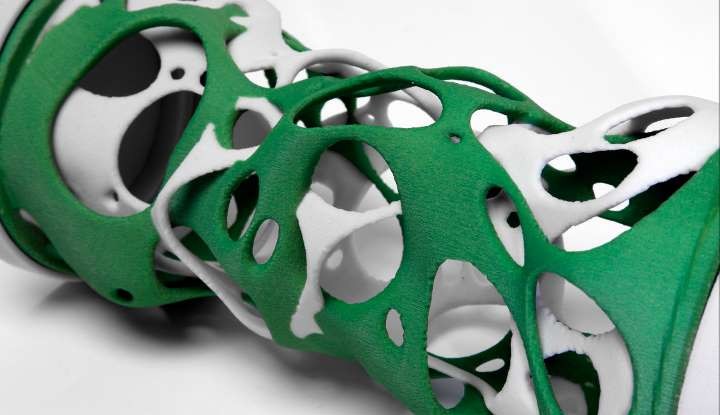
Concept- The concept for Kristin's organic design was based on structures of nature, in particular her research into “tafoni structures” produced during the calcification of porous sandstone.
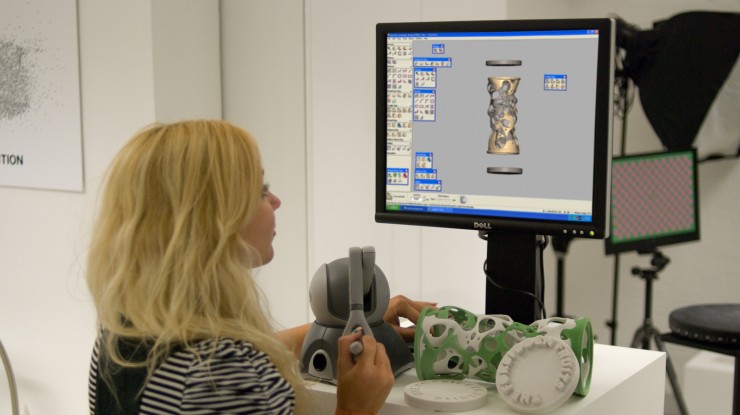
Freeform Design- Designing these organic structures using a typical 3D CAD package would have proved very difficult, however with Inition's guidance Kristin realised the design through the intuitive interface of the Sensable Phantom Omni in conjunction with the Claytools software. Claytools is a design package specially tailored towards haptic modelling, allowing the user to directly sculpt, manipulate and feel the surface of a model through a pen-line interface attached to a motorised force-feedback arm.
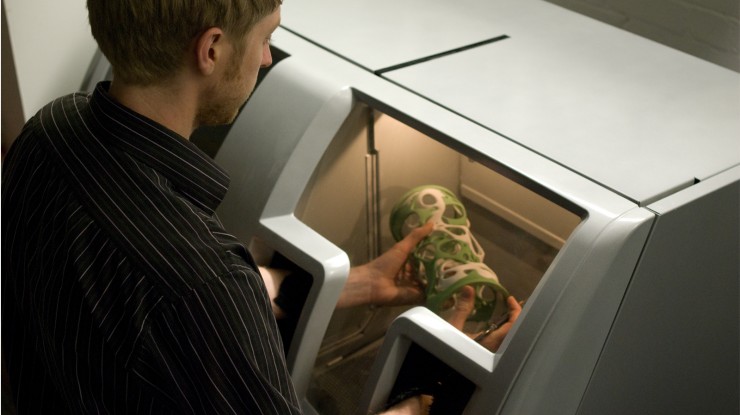
3D Print- After adding colour to the CAD model, the complex design was prepared for print Paul Armand, one of Inition's 3D printing specialists. Our full colour 3D ZPrinter 450 printed out the model over-night including two end caps with extruded lettering.
Results
The final design forms part of Kristin’s degree and was shown at the BA Design Show at the London College of Communication in June 2011.
Thanks to Kristin for creating a great piece; the first thing we've 3D printed that has been created on a haptic device.
The kit we used: ZPrinter 450, Phantom Omni with Claytools software
Check out our Future of 3D blog at fo3d.posterous.com for our latest experiments.
Inition Launch Specialist 3D Production Company Pointy Stick, in Joint Venture
3D production services and technology company Inition has joined forces with accomplished director and creative technologist Michael Lindsay to launch Pointy Stick, a new creative-first production company. Pointy Stick is designed to unleash the power of stereoscopic 3D production and help exploit this nascent medium to its full creative potential.
Live 3D Surgery Broadcast
3D Promo Shoot: Nissan FreeRide Tour
The Brief
Leading extreme sports television producer Boomerang Film approached Inition to produce a high octane 3D promotional video to support Nissan’s sponsorship of the 2011 FreeRide World Tour after a successful collaboration shooting Tony Hawk on his European skateboard tour in Berlin and Brighton for Canal +
Solution
Inition provided stereoscopic consultancy, two portable 3D camera systems, a stereographer and camera assistant for two shooting days as well as 3D post production services including 3D fixing, depth grading and mastering.
Inition were commissioned with the ambitious task of delivering a 3D online post, short promo film and 30 second trailer on a Blu-ray disc within 48 hours of the final shoot. Inition’s team edited approximately 4 – 5 hours of footage into a 2.5 minute compelling promo film in time for the opening of the Nissan FreeRide World Tour.
The offline edit was undertaken by the client in Avid and the final post stages were completed at Inition. We were provided with a graded DPX sequence (Digital Picture Exchange) for the left and right channels which were ingested into our Speedgrade XR suite, where 3D geometry correction and a depth grade were performed. The final piece was then mastered in the side-by-side format for Blu-ray.
The Right Tool for the Job- The client required a stereoscopic video capture system which was as lightweight as possible, able to take POV shots and portable enough to be taken to challenging locations such as mountain faces. Always keen to embrace a challenge, Inition developed a custom built helmet with a mounted 3D rig based around two Toshiba Minicams recording to Nano Flash recorders on Compact Flash cards.
Small enough to achieve an interaxial separation of just 4mm, the custom built rig was highly versatile and could be controlled and genlocked with a camera control unit up to 30 metres away. The recorders were synced (in terms of being triggered for recording) via a breakout cable joined to a single trigger.
Alignment of the cameras was performed before mounting to the helmet with wedges to fix roll and vertical offset. Being a fixed interaxial, calculations were made to allow for the best 3D in the given environment with locked off cameras. The professional athletes were prepped before shooting, so that they were aware of the 3D limits i.e. how close to get to objects.
Results
With its production partner Boomerang Films, Inition delivered an attention holding 3D promotional film to Nissan on schedule, which was taken on tour around major European ski destinations in a Nissan branded truck complete with 4D alpine mountain breeze effects.
3D Shoot: LG 'Rare Butterflies' Commercial
As part of LG’s multi million pound 3DTV advertising campaign, Inition worked with Framestore to shoot a 3D cinema advert which aims to show film-lovers how the 3D experience can be recreated in their living rooms. The campaign for media agency Mindshare was directed by The IT Crowd star Richard Ayoade. It features comedy duo Tim Key and his sidekick Lloyd Woolf who take viewers on a brief history of 3D through to the latest developments and what the future holds.
The Brief
Framestore required a versatile, mobile and high-quality stereoscopic 3D filming solution and the expertise to operate it on crane for their one-shot-wonder treatment.
Solution
Inition specified the SI-2K mini system which offers a great compromise between size and quality. Combined with our matched UltraPrime lenses this offered a cost-effective and highly maneuverable solution on this technically demanding shoot. 3 Inition crew were on hand to build and run the rig (3D rig tech and assistant and stereographer).
Results
The advert is a tongue-in-cheek take on current formulaic 3D showreels and starts with Woolf dressed up as Godzilla destroying a cardboard city below him. The sequence then pans through other popular 3D viewing genres such as football and nature, before ending in a stage set front room with Key and Woolf on the sofa and the strap line "Bringing the magic of 3D home with LG".
Inition's Andy Millns was the stereographer on-set. Post-production at Framestore included adding VFX to the live action sequence which was on-lined by respected VFX artist and post-production consultant David Cox.
"I was very happy with the material from the shoot, the optical line up between the cameras was very good and the colour matching was as close as I've seen." David Cox, VFX/Mistika consultant.
The cinema advert marks LG's first foray onto the silver screen and will be shown alongside screenings of 3D movies Tron: Legacy and the new Chronicles of Narnia film, starting on December 10th.
**UPDATE** LG were so happy with FrameStore's ad that they commissioned a second-part. Framestore came back to Inition who provided the same team and kit for the second shoot which went as flawlessy as the first.
You can watch the advert here (in 2D only) or pay us a visit to see in 3D!
Ford C-MAX Campaign: AR with Gestural Interface
The Ford C-MAX augmented reality campaign ran for two weeks across ten shopping malls with over 125,000 curious shoppers interacting with Ford’s Grand C-MAX vehicle. A selection of on-screen icons allowed participants to explore various features of the car including 'Door Slide', 'Seating', 'Power Tail' and 'Spin' with a 'Minority Report' style gesture-controlled interface.
The Brief
The brief from Ford demanded us to track users in the most natural way possible to allow them to 'play' with an interactive product advert. No markers or other symbols could be relied on. It also had to ignore people walking past while allowing precise control and selection from the interface.
FORD C-max DOOH AR campaign from Inition on Vimeo.
Solution
Inition were approached by digital production company Grand Visual who asked if this was possible and thanks to our recent distribution agreement for the Panasonic D-Imager (a Microsoft Kinect-like depth or Z camera) we provided a simple proof-of-concept demo within one day which secured the project.
Over the next few weeks, our in house team of C++ developers developed an application based on OpenFrameWorks and OpenCV SDKs to code the real-time sensing and video display engine. A sophisticated blob tracking and depth thresholding algorithm sensed the participant's hands allowing the car to follow the user's movements. A flocking algorithm gave a fluid, graceful movement around the screen with the optimum amount of 'bounce'. Full HD resolution, portrait graphics, webcam capture, depth and video camera aspect matching and alignment, gestural user interface, interaction logging for usage analysis and hardware fault tolerance were added before going live.
Fine Tuning and Feedback at Every Stage- An important part of the project was the ability to "fine tune" and "play" with all the control parameters via an on-screen interface. On-screen debugging and depth camera modes allowed us to optimise every aspect of the interaction experience. Our development team provided regular “work in progress” videos and executable versions for the client allowing feedback to be incorporated at every stage.
Inition were present for repeated on-site testing with JCDecaux prior to deployment to ensure the software could cope with the rigours of the real-world environment. Issues included reflection scatter from glass shop windows which were tackled with temporal and contrast filtering of the depth image.
Results
- Across ten shopping malls 125,000 customers interacted with Ford's Grand C-MAX vehicle.
- Check out the video to see the installation in action!
Future of 3D #3 : Design, Print, Fly!
The Brief
Co-founder and director of Intion Stuart Cupit, also keen photographer and kite-flyer, decided to set himself a challenge to build a rig capable of taking panoramic aeriel photos from his parafoil kite...
The rig needed moving parts, had to be light-weight but strong enough to hold servos and a digital camera and withstand the odd crash landing.
Solution
Stuart designed the rig using 3D Studio Max and included 5 independent moveable stages, a complete gear system, fittings for 4 servos, a microcontroller, batteries and, most importantly, a digital camera.
The final design was printed out in one go (yes, no assembly!) using our Invision-XT 3D printer. The various joints and gears were designed in place with the 0.1mm clearance between any two parts required to allow them to move independently. The VisiJet SR200 build material used is strong enough to be for functional finished products.
The gears, axels and sleeves freely revolve and the fleixble nature of the material, when printed in thin sections, allowed the servos to be held in place by sprung hinged latches. The servos follow a pre-recorded set of moves using a Milinst Wizard board.
Results
- A Picavet suspension allowed the camera rig to self-level and prevents twisting. A geared mechanism reduced the speed of one of the servos by 20 to 1 to allow the rig to be rotated. The gears were printed in place and once support material is removed just work with no assembly!
- The Flight: The whole rig was attached to a Sutton Flowform 16 kite using a pair wire hangups on 200m of cord. The kite needed a 25mph wind to get the 1kg rig into the air. Flown from Hamstead Heath, the rig took 50 blurry photos the first time! The second flight got some great shots looking south across London, and some bemused looks from on-lookers!
Check out our 3D Printing Service and our Future of 3D blog at fo3d.posterous.com for our latest experiments in 3D.
About our 'Future of 3D' series
The 'Future of 3D' series is about exploring the boundaries of future 3D technology through non-commercial creative projects. Supporting this type of work is core to Inition's core values of developing new uses of 3D technology, supporting creativity and nurturing the passion of it's staff and collaborators. If you have an idea for a 'Future of 3D' project, we'd love to hear from you.
Future of 3D: #1 - Scan, Print, Explode!
For our first 'Future of 3D' project we decided to have some 3D fun with Shannon's head to celebrate our 10th Birthday and the launch of our 'Future of 3D' series.
This project combined a wide range of our skills and 3D technologies. But mainly we enjoyed it because it involved blowing stuff up! If you're interested in finding out more, make sure you watch the video above.
Some of the kit we used: ZPrinter 450, Mephisto EX Scanner, Phantom/Quasar 3D Stereoscopic Filming Rig
We'd like to point out that no Shannons were harmed in this project, although strangely enough he had a slight headache afterwards. Check out our Future of 3D blog at fo3d.posterous.com for our latest experiments.

About our 'Future of 3D' series
The 'Future of 3D' series is about exploring the boundaries of future 3D technology through non-commercial creative projects. Supporting this type of work is core to Inition's core values of developing new uses of 3D technology, supporting creativity and nurturing the passion of it's staff and collaborators. If you have an idea for a 'Future of 3D' project, we'd love to hear from you.

Live 3D Transmissions : Six Nations Rugby Live in 3D for O2
The Brief
40 cinemas across the country screened England’s home RBS Six Nations games live in 3-D. Archibald Ingall Stretton commissioned 3D specialists Inition to produce the matches which became the largest ever UK sports event to be broadcast live in 3D.
Solution
Using the latest 3D camera technology, the matches were captured from seven camera positions providing a comprehensive view of the game which included replays, match statistics and on-screen graphics. Inition worked with outside broadcast experts SIS Live and used 3D 'Quasar' rigs from Element Technica for the shoot. Broadcast graphics specialists Wurmsers creating bespoke stereoscopic graphics for the game.
The BBC is the UK TV rights holder for the 6 Nations – played between England, Scotland, Wales, Ireland, France and Italy – and assisted Inition in the broadcast. Inition has worked on a number of 3D productions from football and ice hockey to track and music events. Inition were also the 3D experts behind the 3D transmissions of England’s clash with Scotland at Murrayfield, in 2008, as part of a 3D test for the BBC.
Results
Forty Odeon and Cineworld cinemas screened the matches, beginning with England’s official centenary game, against Wales on February 6, as part of a deal with O2, the England sponsor. The match against Ireland on February 27 was also screened live in 3-D.
Read TVB Europe's inside story on the project here
Remote Avatar: Gadget Show Virtual Pesenter Challenge
The Brief
The producers of North One Television approached 3D creative services company Inition, asking us to provide the technical expertise for an ambitious 'virtual presenter' challenge.
Solution
Inition helped presenter Suzi Perry to win the ‘virtual presenter’ challenge (Season 15, Episode 4) in which she and Jon were invited to find the best way to present the show without actually being in the studio. Whilst Jon commissioned an android version of himself and placed it in the studio to take his place, Suzi came to Inition to make use of our motion capture technology.
Based on real-time 3D animation software Autodest MotionBuilder, LILA is Inition’s markerless motion capture solution which can provide show stopping interactive installations for brands, exhibitions, tours and marketing agencies.
Using LILA, Inition were able to capture the motion of Suzi in London and transmit this data to Birmingham to drive an avatar which was composited in the Gadget Show studio, all in real time.
Without any calibration required, Suzi stepped into the holo-deck style cube at Inition’s London studios where her silhouette was tracked by 14 x2D cameras. No markers or any special clothing were required. The vision processor software calculated a 3D mesh of her body from these views and a digital skeleton was applied using the Organic Motion plugin.
The frame-by-frame motion co-ordinates from the data were transmitted to the MotionBuilder system at North One TV studios via a special driver which then applied Suzi’s features- including clothes, hair, skin tones etc. The avatar of Suzi was composited into the studios of The Gadget Show next to the real co-presenter Otis and the android version of Jason Bradbury.
Suzi’s avatar character included full face expressions and mouth shapes driven by her voice, fed through LILA’s voice recognition software. The composited footage was sent back to Inition’s Shoreditch studios via Skype which Suzi could monitor on a screen, seeing exactly what the public would see.
Results
This project posed several challenges, not least because of the processing power required to deliver the avatar in real time. This was the first time a motion capture system had been used to drive another avatar over the Internet. By chosing to approach Inition for help, Suzi beat Jason's android by 16 points to just 12.
Based on the success of this project, North One Television decided to invite Inition to help create fun and innovative crowd games to be played at Gadget Show Live, a consumer event based on the television show. Read more about this here.
The LILA motion capture is a complete attention grabbing solution which is available for events, promotions and exhibitions. As well as hire of the LILA system itself, Inition also provide a complete production service with the hardware, software, and creative design of the characters, environments and interactions.